Exercise: determinants
Goal
- Compute the determinant of a \(2\times2\) matrix using one short formula.
- (Optional) Compute the determinant of a \(3\times3\) matrix by cofactor expansion.
- Recognise when a determinant is \(0\) and know what that means in one sentence.
The rule
For a \(2\times2\) matrix the determinant is one number, found by: \[ \det\begin{bmatrix} a & b \\ c & d \end{bmatrix} = ad - bc. \]
Multiply the two numbers on the main diagonal (\(a\) and \(d\)), then subtract the product of the other two (\(b\) and \(c\)). That is it.
Tiny worked example. \[ \det\begin{bmatrix} 2 & 1 \\ 3 & 4 \end{bmatrix} = (2)(4) - (1)(3) = 8 - 3 = 5. \]
Optional: \(3\times3\). For a \(3\times3\) matrix we use cofactor expansion along the first row: \[ \det\begin{bmatrix} a & b & c \\ d & e & f \\ g & h & i \end{bmatrix} = a\det\begin{bmatrix} e & f \\ h & i \end{bmatrix} - b\det\begin{bmatrix} d & f \\ g & i \end{bmatrix} + c\det\begin{bmatrix} d & e \\ g & h \end{bmatrix}. \]
Note the signs: plus, minus, plus. Each small determinant is just the \(2\times2\) rule again, on the matrix you get by crossing out the row and column of the front number.
What \(\det = 0\) means. If \(\det(A) = 0\) the matrix is called singular: a system \(A\mathbf{x}=\mathbf{b}\) then has no unique solution. If \(\det(A) \neq 0\) there is exactly one solution, and \(A\) has an inverse.
What the number means: an area
The two columns of \(A\) span a parallelogram: the image of the unit square under \(A\) (see Matrices as transformations). Its area is the determinant.
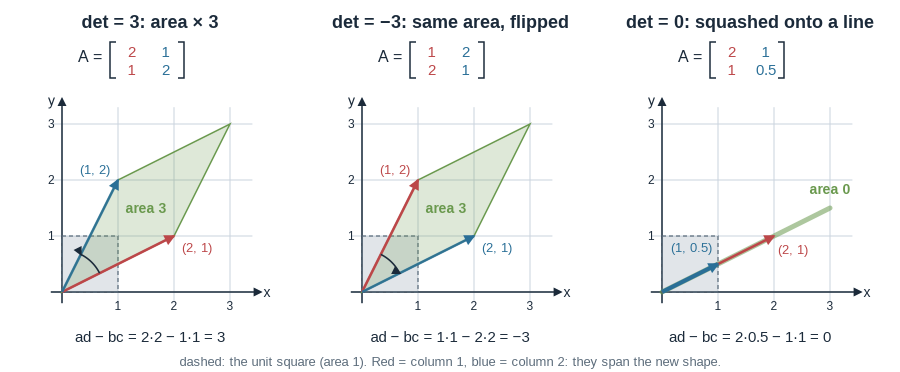
- \(\lvert \det A \rvert\) is how much \(A\) scales areas (here 3 times).
- A negative sign means the picture is flipped: the turn from column 1 to column 2 goes clockwise.
- Zero: the columns are parallel, everything collapses onto a line, and \(A\) cannot be undone.
det(matrix(c(2, 1,
             1, 2), nrow = 2, byrow = TRUE))   # 3
Problems
Work these on paper. Start at the top — the first ones are almost trivial.
2×2 determinants
- \(\det\begin{bmatrix} 1 & 0 \\ 0 & 1 \end{bmatrix}\)
- \(\det\begin{bmatrix} 2 & 0 \\ 0 & 3 \end{bmatrix}\)
- \(\det\begin{bmatrix} 5 & 0 \\ 0 & 4 \end{bmatrix}\)
- \(\det\begin{bmatrix} 1 & 2 \\ 0 & 3 \end{bmatrix}\)
- \(\det\begin{bmatrix} 2 & 1 \\ 1 & 2 \end{bmatrix}\)
- \(\det\begin{bmatrix} 3 & 2 \\ 1 & 4 \end{bmatrix}\)
- \(\det\begin{bmatrix} 4 & 1 \\ 2 & 3 \end{bmatrix}\)
- \(\det\begin{bmatrix} 6 & 5 \\ 2 & 2 \end{bmatrix}\)
- \(\det\begin{bmatrix} -1 & 2 \\ 3 & 1 \end{bmatrix}\)
- \(\det\begin{bmatrix} 2 & -3 \\ -1 & 4 \end{bmatrix}\)
Is the determinant zero?
- \(\det\begin{bmatrix} 1 & 2 \\ 2 & 4 \end{bmatrix}\) — is it \(0\)?
- \(\det\begin{bmatrix} 3 & 1 \\ 6 & 2 \end{bmatrix}\) — is it \(0\)?
- \(\det\begin{bmatrix} 2 & 1 \\ 4 & 3 \end{bmatrix}\) — is it \(0\)?
3×3 determinants (cofactor expansion, optional)
- \(\det\begin{bmatrix} 1 & 0 & 0 \\ 0 & 1 & 0 \\ 0 & 0 & 1 \end{bmatrix}\)
- \(\det\begin{bmatrix} 2 & 0 & 0 \\ 0 & 3 & 0 \\ 0 & 0 & 4 \end{bmatrix}\)
- \(\det\begin{bmatrix} 1 & 2 & 0 \\ 0 & 3 & 1 \\ 0 & 0 & 2 \end{bmatrix}\)
- \(\det\begin{bmatrix} 1 & 2 & 3 \\ 0 & 1 & 4 \\ 0 & 0 & 2 \end{bmatrix}\)
- \(\det\begin{bmatrix} 2 & 1 & 0 \\ 1 & 3 & 1 \\ 0 & 1 & 2 \end{bmatrix}\)
Check in R
In R the function is det. You build a matrix with matrix, filling by column (byrow = FALSE is the default), or pass byrow = TRUE to fill by row as written on paper.
A <- matrix(c(2, 1,
              3, 4), nrow = 2, byrow = TRUE)
det(A)
# [1] 5      (matches the worked example)

B <- matrix(c(1, 2,
              2, 4), nrow = 2, byrow = TRUE)
det(B)
# [1] 0      (singular: rows are multiples of each other)

C <- matrix(c(1, 2, 3,
              0, 1, 4,
              0, 0, 2), nrow = 3, byrow = TRUE)
det(C)
# [1] 2      (triangular: product of the diagonal)
Hints
Diagonal product minus anti-diagonal product: \(ad - bc\). Write the four numbers down first, then plug in.
If a number is \(0\), the term it multiplies is \(0\) and disappears. For example \(\det\begin{bmatrix} a & 0 \\ c & d \end{bmatrix} = ad - 0 = ad\).
Compute \(ad - bc\) as usual. If one row is just a multiple of the other (e.g. the second row is \(2\times\) the first), the result will be \(0\).
Expanding along the top row, the signs are \(+,\,-,\,+\). For each front number, cross out its row and column and take the \(2\times2\) determinant of what is left.
If everything below (or above) the diagonal is \(0\), the determinant is just the product of the diagonal entries. Use this to check problems 14–17.
Step-by-step solutions
Problem 1. \(\det\begin{bmatrix} 1 & 0 \\ 0 & 1 \end{bmatrix} = (1)(1) - (0)(0) = 1 - 0 = 1.\)
Problem 2. \((2)(3) - (0)(0) = 6 - 0 = 6.\)
Problem 3. \((5)(4) - (0)(0) = 20 - 0 = 20.\)
Problem 4. \((1)(3) - (2)(0) = 3 - 0 = 3.\)
Problem 5. \((2)(2) - (1)(1) = 4 - 1 = 3.\)
Problem 6. \((3)(4) - (2)(1) = 12 - 2 = 10.\)
Problem 7. \((4)(3) - (1)(2) = 12 - 2 = 10.\)
Problem 8. \((6)(2) - (5)(2) = 12 - 10 = 2.\)
Problem 9. \((-1)(1) - (2)(3) = -1 - 6 = -7.\)
Problem 10. \((2)(4) - (-3)(-1) = 8 - 3 = 5.\)
Problem 11. \((1)(4) - (2)(2) = 4 - 4 = 0.\) Yes, the determinant is \(0\) (the second row is \(2\times\) the first).
Problem 12. \((3)(2) - (1)(6) = 6 - 6 = 0.\) Yes, it is \(0\) (second row is \(2\times\) the first).
Problem 13. \((2)(3) - (1)(4) = 6 - 4 = 2.\) No, it is \(2 \neq 0\).
Problem 14. Expand along the top row: \[ 1\det\begin{bmatrix} 1 & 0 \\ 0 & 1 \end{bmatrix} - 0\det\begin{bmatrix} 0 & 0 \\ 0 & 1 \end{bmatrix} + 0\det\begin{bmatrix} 0 & 1 \\ 0 & 0 \end{bmatrix} = 1(1) - 0 + 0 = 1. \]
Problem 15. Top row is \(2, 0, 0\): \[ 2\det\begin{bmatrix} 3 & 0 \\ 0 & 4 \end{bmatrix} - 0 + 0 = 2(12 - 0) = 2(12) = 24. \] (Diagonal shortcut: \(2\cdot3\cdot4 = 24\).)
Problem 16. Top row \(1, 2, 0\): \[ 1\det\begin{bmatrix} 3 & 1 \\ 0 & 2 \end{bmatrix} - 2\det\begin{bmatrix} 0 & 1 \\ 0 & 2 \end{bmatrix} + 0. \] First minor: \((3)(2)-(1)(0) = 6\). Second minor: \((0)(2)-(1)(0) = 0\). So \(1(6) - 2(0) + 0 = 6\). (Diagonal shortcut: \(1\cdot3\cdot2 = 6\).)
Problem 17. Top row \(1, 2, 3\): \[ 1\det\begin{bmatrix} 1 & 4 \\ 0 & 2 \end{bmatrix} - 2\det\begin{bmatrix} 0 & 4 \\ 0 & 2 \end{bmatrix} + 3\det\begin{bmatrix} 0 & 1 \\ 0 & 0 \end{bmatrix}. \] Minors: \((1)(2)-(4)(0) = 2\); \((0)(2)-(4)(0) = 0\); \((0)(0)-(1)(0) = 0\). So \(1(2) - 2(0) + 3(0) = 2\). (Diagonal shortcut: \(1\cdot1\cdot2 = 2\).)
Problem 18. Top row \(2, 1, 0\): \[ 2\det\begin{bmatrix} 3 & 1 \\ 1 & 2 \end{bmatrix} - 1\det\begin{bmatrix} 1 & 1 \\ 0 & 2 \end{bmatrix} + 0. \] First minor: \((3)(2)-(1)(1) = 6 - 1 = 5\). Second minor: \((1)(2)-(1)(0) = 2\). So \(2(5) - 1(2) + 0 = 10 - 2 = 8\).